Session References and Introspection
It is now possible for Bionic to reference and introspect past sessions, making it much more capable of handling long-term context and retrieving forgotten details. You can also reference sessions directly from the composer using an @ mention.
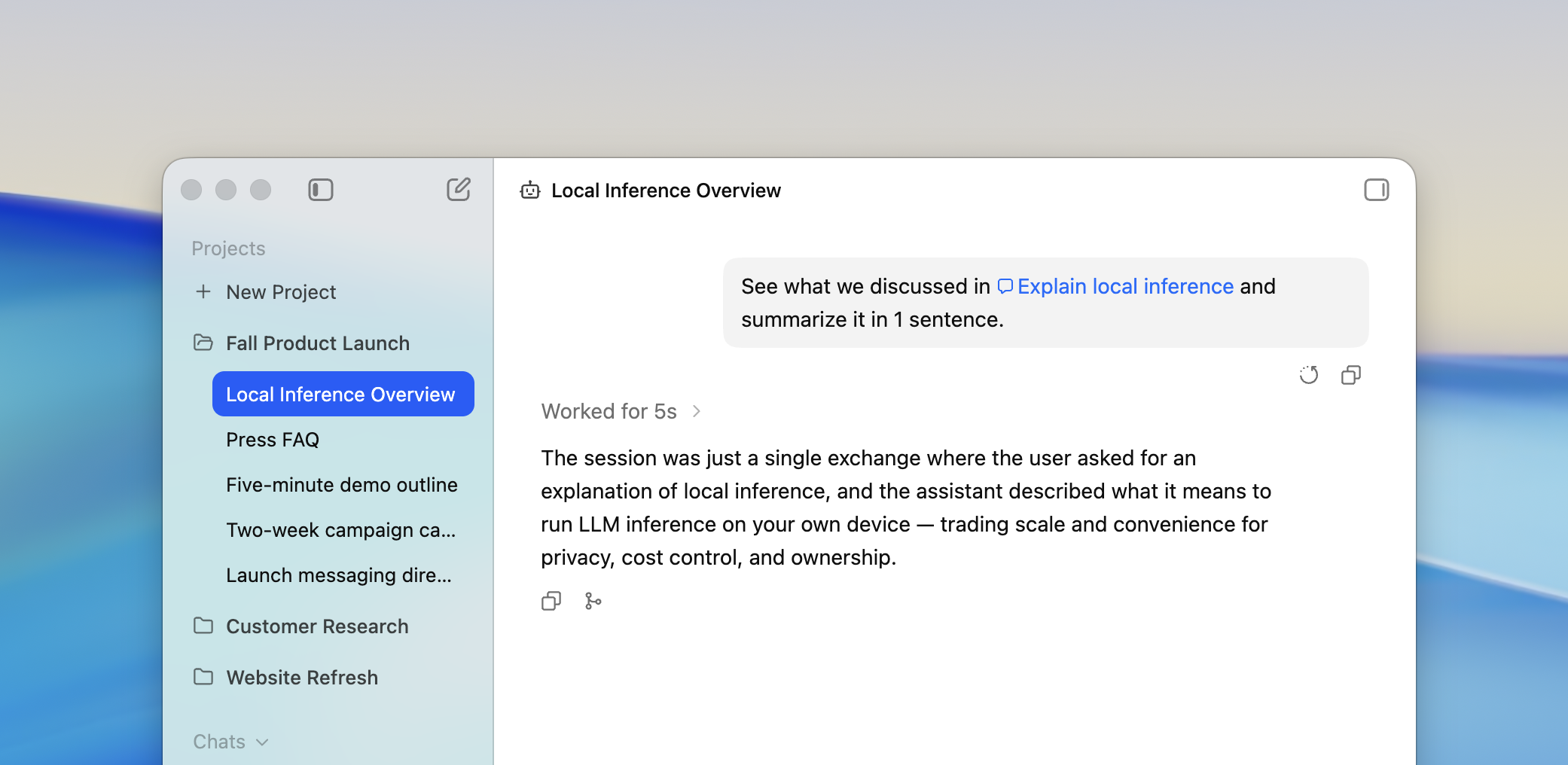
Reference another session directly from the composer with an @ mention.
Models are increasingly good at finding information in a large "haystack" using search tools. Often a vague mention is all that's needed for a capable model to find relevant parts of the codebase. This got us thinking: what if we gave the agent the ability to read/search through session transcripts from both the current session (which may be long and have undergone many compactions) and other sessions, even in other projects?
Introducing Introspection
Bionic now has a set of tools and built-in skills we call "Introspection". These tools allow the agent to recover details that were previously forgotten or omitted during compaction. It essentially gives the agent a way to "look back" at its own history and fill in gaps in its knowledge.
This comes in handy over very long sessions. Design decisions, pitfalls, environment info, and many other things are now just one introspection away.
While we already have multiple tricks that improve the performance of the agent after compactions (which we will eventually write a blog post about), there is a noticeable leap in the ability to adhere to the plan in extremely long-horizon tasks, tasks that take multiple hours to complete. Usually, with compaction, as soon as a piece of information that is not classified as "always keep" is missed in a handoff, the information is lost forever.
Nevertheless, with introspection, the agent is able to just read the transcript and get the information back.
The following diagram illustrates how introspection allows a compacted Bionic session to recover details from its persisted transcript.
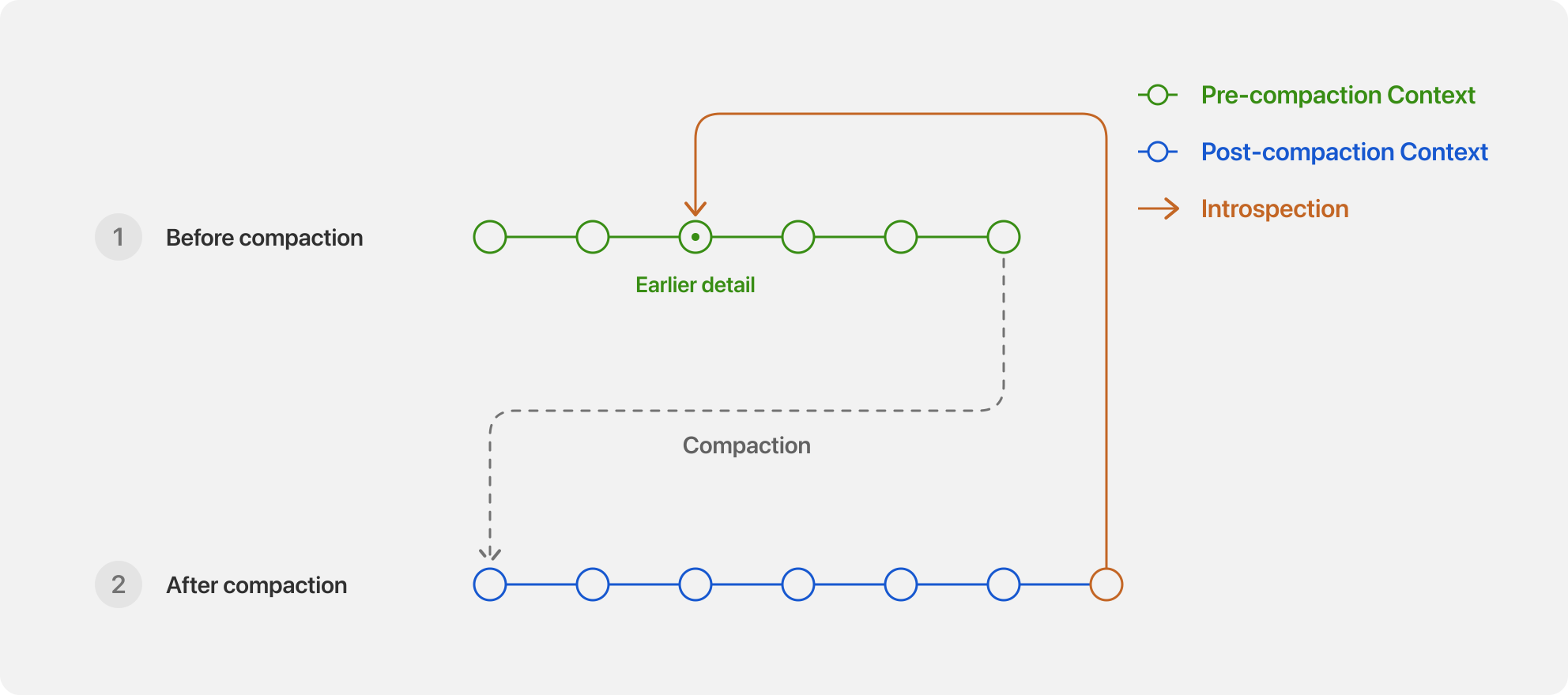
Introspection searches the persisted transcript and recovers details omitted during compaction.
Tool Design
As with anything we build in Bionic, we are extremely careful about the context, and we don't want to fill it with tool definitions. All tools used for introspection are implemented as progressively disclosed tools, documented in a built-in SKILL. The agent will only load the relevant tools and documentation when it sees the need to introspect.
In order to further save context, we also employ "tiered" tool designs for introspection, meaning we provide tools that read/search transcripts at a high level with heavy truncation. Once Bionic identifies a message of interest, the agent may retrieve the full content of the message with a separate tool call.
We also provide options to filter out things like tool call results, since those are normally not useful but can be accessed if needed.
Reading other sessions requires permission
One thing to be careful about with introspection is cross-session contamination. Sometimes, sessions reach a dead end or reflect some abandoned or undesired path. We don't want the agent to proactively read those sessions and contaminate the current session. To address this, we gate the ability to read other sessions behind a permission dialog. Reading the agent's own transcript does not require approval.
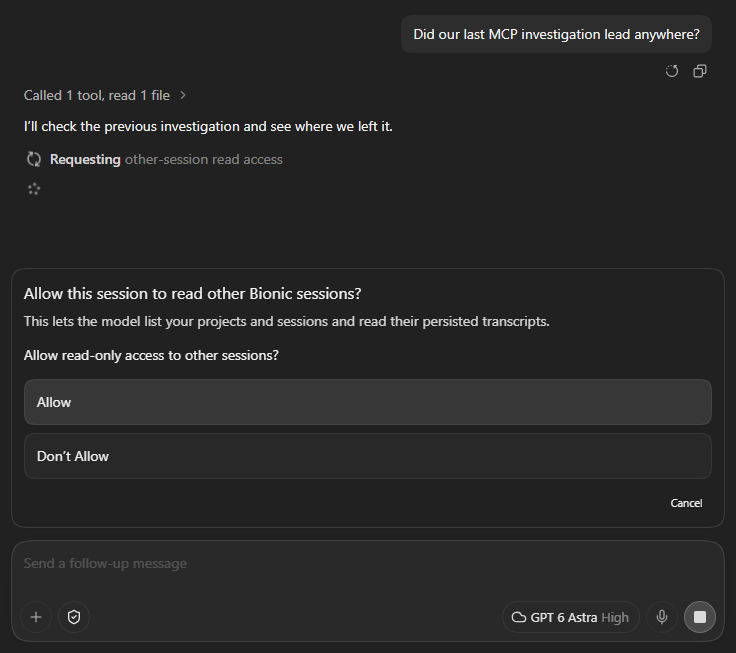
Reading other Bionic sessions requires explicit permission; reading the current session does not.
Reference other sessions with @
If you have a past session you want the agent to reference, you can easily do so with the @ syntax. This works across projects, too.
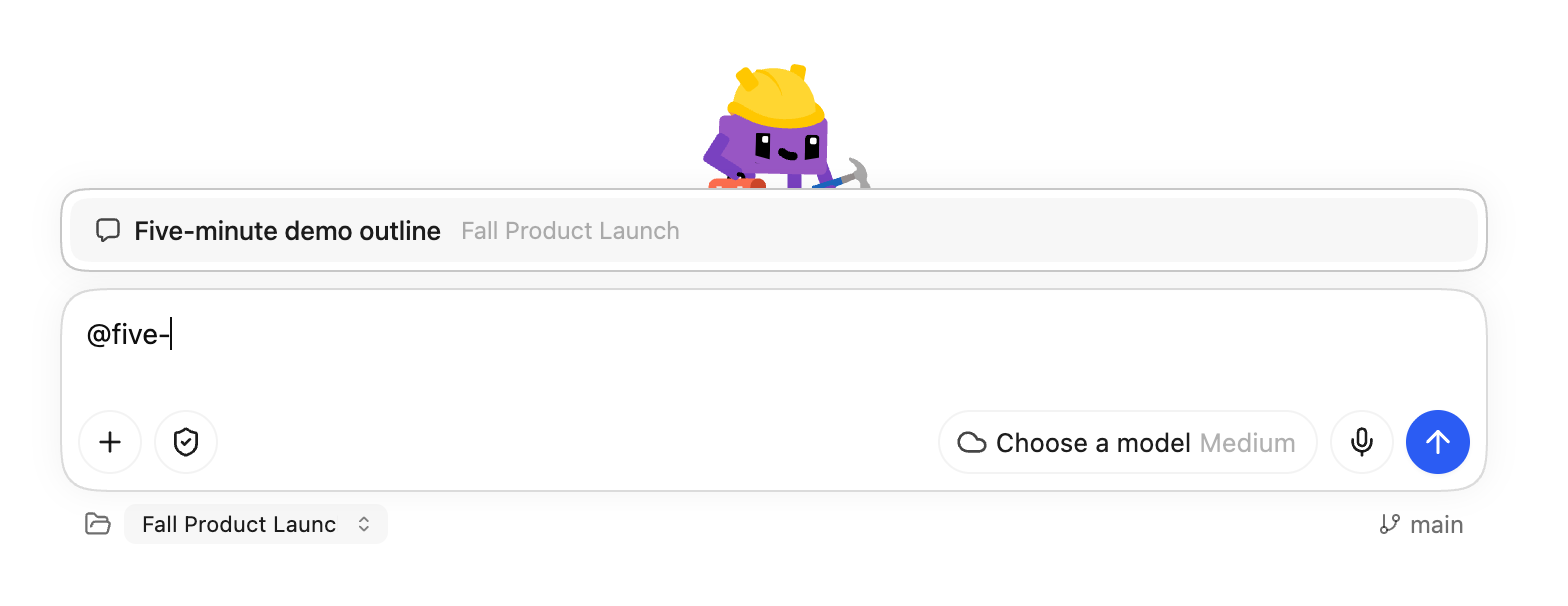
Reference another session directly from the composer with an @ mention.