Flint
Flint
Recursive Flint is a 39.8B Mixture-of-Experts model for coding agents, with approximately 2.5B active parameters per token, reasoning, multi-turn tool use, and a 262K-token context window.
Memory Requirements
To run the smallest Flint, you need at least 24 GB of RAM.
Capabilities
Flint models support tool use and reasoning. They are available in gguf.
About Flint
Recursive is the team behind Flint and Eureka Machine, an automated AI research system that proposes, implements, and validates improvements to model architecture, training, and inference. Recursive used this system throughout Flint’s development.
Recursive Flint is a text-only language model built for coding agents. Trained from scratch by Recursive, it is designed to investigate codebases, fix bugs, implement features, and write tests through reasoning and multi-turn tool use.
Model overview
- Sparse MoE: 39.8B total parameters with approximately 2.5B active per token, including the output head. The active body alone is approximately 2.2B parameters.
- 262K context: a documented configuration of 262,144 tokens, shared between the prompt and generated output.
- Coding and tool use: supports reasoning and OpenAI-compatible tool calls. Applications should preserve returned reasoning content in conversation history using the checkpoint's chat template.
- Hybrid attention layout: 35 sliding-window and 14 full-attention layers across a 49-layer decoder-only Transformer.
Recursive-reported benchmark results
| Benchmark | Flint BF16 | Flint NVFP4 |
|---|---|---|
| Terminal-Bench 2.1 | 54.9 | 53.7 |
| SWE-bench Pro v2 | 89.7 | 88.5 |
| SWE-bench Verified | 74.2 | 74.1 |
| LiveCodeBench v6 | 80.3 | 80.8 |
| IFBench | 89.2 | 88.1 |
| IFEval | 95.1 | 94.6 |
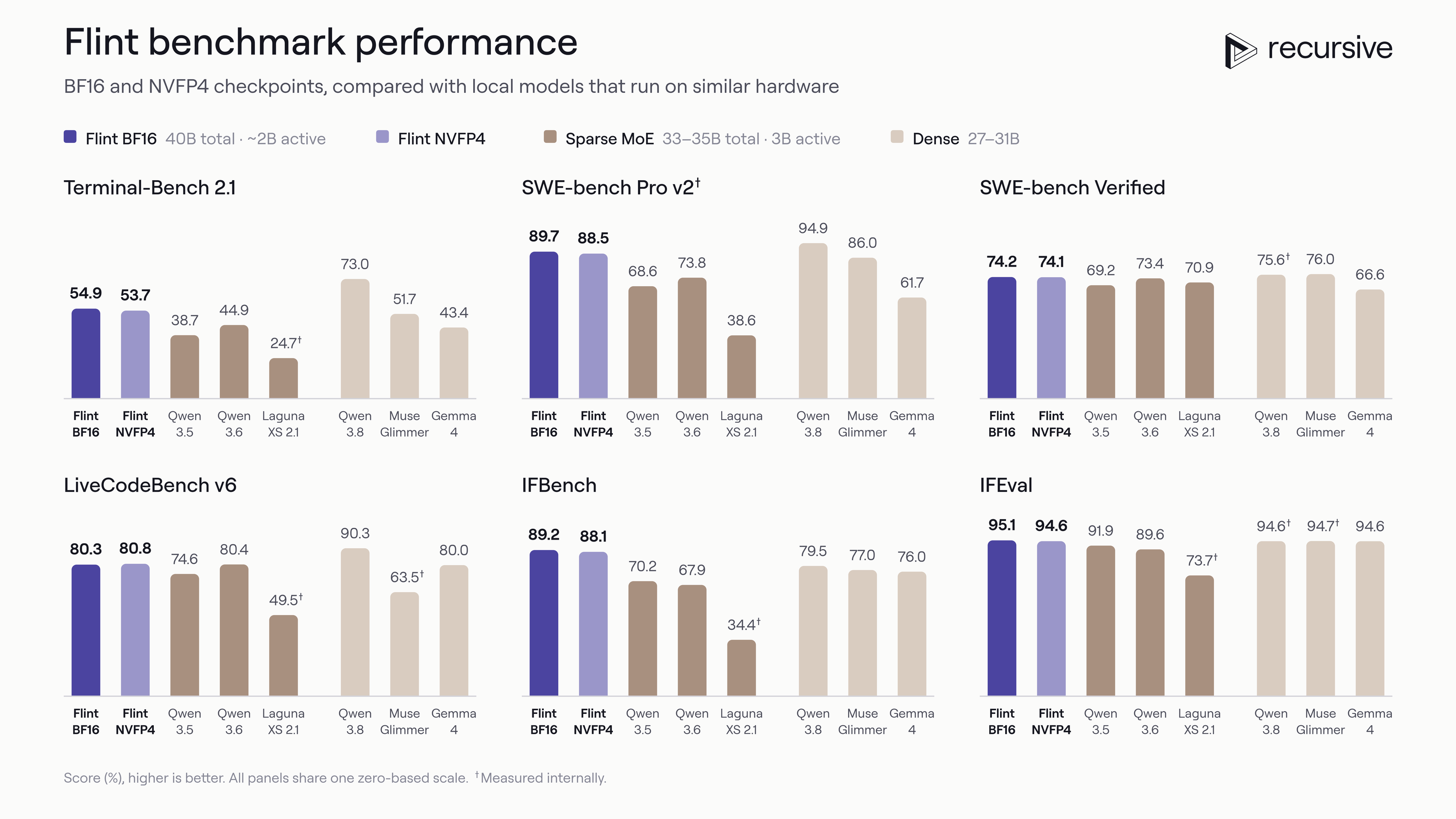
Results and chart reported by Recursive. Flint evaluations use temperature 1.0, top-p 0.95, and top-k 20. Terminal-Bench uses Terminus 2; SWE-bench uses mini-swe-agent. Agentic scores report average pass@1 over at least five attempts. In the chart, † marks Recursive-measured comparison scores; other comparison scores are developer-reported. Evaluation setups vary: Flint's Terminal-Bench result counts solutions obtained through web retrieval as unsuccessful. Results are for the named checkpoint precisions, not measurements of every local quantization.
Local use
The linked Flint artifact provides GGUF downloads and currently lists a 24 GB minimum system-memory requirement. Actual memory use and generation speed depend on quantization, runtime, hardware, and context length; the full 262K context is not guaranteed to fit within that minimum.
For generation, Recursive recommends temperature 1.0, top-p 0.95, and top-k 20, with at least 32,768 output tokens, including reasoning, for hard problems. Long reasoning can increase latency or exhaust the output budget. Review generated code and enforce permissions around tool execution.
License
Flint is released under the Apache 2.0 License. See the official model card for specifications, evaluation details, and serving guidance.